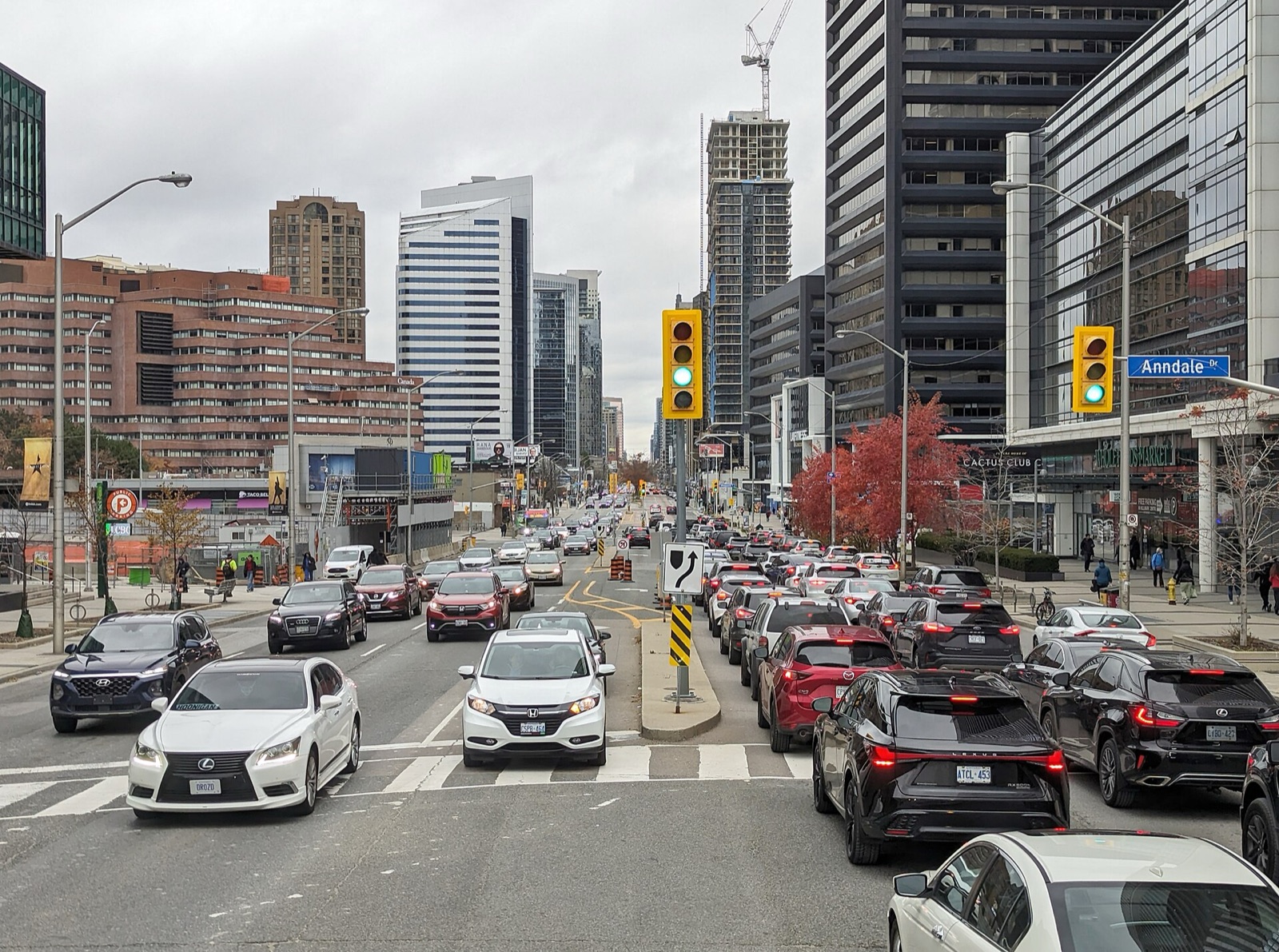
They take four metres of your frontage and pay you for four metres of land. Then they build outside your door for three years.
Along Ontario's transit corridors, the pattern repeats. A partial taking removes a modest strip for a station entrance, a working easement, or a widened sidewalk. The authority's appraisal values the strip, and the number looks almost reasonable. What it does not capture is the three years of hoarding, closed lanes, dust, noise, and lost parking that follow, and for a business fronting that work, those three years are the real loss.
Business loss is a recognised head of compensation under the Expropriations Act. It is also the head that depends most completely on evidence, which is why so many businesses recover a fraction of what the disruption actually cost them.
Where this is happening now
The Eglinton Crosstown West Extension is the clearest current example. Tunnelling on the 9.2 kilometre extension from Mount Dennis to Renforth finished in 2026, and excavation is underway at station sites along Eglinton Avenue West at Martin Grove Road, Kipling Avenue, Islington Avenue, and Royal York Road. Those stations are underground, but the excavation and staging are at surface level on a commercial arterial, in front of businesses that have to keep trading through it.
The same dynamic applies along the Ontario Line, the Yonge North and Scarborough subway extensions, the Hurontario corridor through Mississauga and Brampton, and GO expansion works across the region.
What business loss actually covers
- Lost profits during and after the works, attributable to the taking and the construction rather than to the general market.
- Relocation costs, if you have to move: physical moving, fit-out at the new premises, and duplicate rent through a transition.
- Re-establishment, the cost of getting the business back to where it was in a new location.
- Goodwill attributable to the move, where a customer base tied to a location does not follow you.
Where the works reduce the value of land you keep rather than your trade specifically, that is injurious affection and it is a separate claim. Most real files involve both, and they should be pleaded and evidenced as distinct heads rather than blurred together.
If no land was taken from you, there is a one-year clock
Most businesses along a corridor lose no land at all. They just get the construction. That claim runs under section 21 as injurious affection where no land is taken, and section 22 requires written notice to the authority within one year after the damage was sustained or after it became known, failing which the claim is barred entirely. It is the one genuinely unrecoverable deadline in this area, and it can expire while you are still building the baseline records described below. If construction has already affected you, give notice now and assemble the evidence afterwards. Note too that a no-taking claim must clear the Antrim Truck Centre test: damage from construction rather than use of the works, which would have been actionable but for statutory authority.
The evidence problem, and the fix
Here is the difficulty. A business owner knows with certainty that trade fell off when the hoarding went up. Proving it two years later, to a tribunal, against an expert retained by the authority, is a different exercise entirely. An impression is not evidence. A trend line is.
The businesses that recover properly are the ones that started keeping records before they had a claim. If construction is coming to your street, begin now:
- Monthly revenue, broken out by category if your system allows, for at least the two years before the works start. This is your baseline and you cannot create it retroactively.
- Customer counts or transaction counts, which separate a drop in footfall from a drop in average spend.
- Photographs, dated, of hoarding, lane closures, blocked entrances, removed parking, and altered sidewalks. Take them monthly.
- Access and parking changes, recorded as they happen, including how many spaces were lost and for how long.
- Delivery and loading disruption, including any additional cost you incurred to work around it.
- Correspondence with the authority, the contractor, and the city.
A business loss claim of any size will need a business valuator or forensic accountant, not just a land appraiser. Their work is only as good as the records you hand them.
Who pays for all of that
Often the authority. Under section 32, where the Ontario Land Tribunal awards you 85% or more of the amount the authority offered, it must order the authority to pay your reasonable legal, appraisal, and other costs actually incurred in determining compensation.
Two qualifications keep that from being a guarantee. In Shergar Development Inc. v. Windsor (City) the Court of Appeal held that "the amount offered" is not limited to the section 25 offer, so an authority that improves its offer during the proceeding raises the bar you have to clear, and below 85% of that later figure costs fall to the Tribunal's discretion under section 32(2) and can be ordered against you. And the comparison is total award against total offer, not head by head.
The honest answer to whether a small business can afford to push back is therefore: usually yes, but it depends on how offers are handled through the proceeding, which is a large part of what counsel is for.
See also injurious affection and business loss and what to do after an expropriation notice. City pages for Etobicoke and Mississauga cover the local projects in more detail.